Wednesday, March 27, 2013
A Shameless Plug of Your Contest Subject
Ladies and gentlemen, I would like to take this opportunity to introduce the esteemed Mr. Roger White, author, editor, and dog-walker extraordinaire. Roger is my newest agenting client--and potentially your ticket to all the fame and glory that a blog with 38--wait, down to 35--followers has to offer. Did I mention that like 70 people are following me on Twitter?
"Ethan, you have seventeen Twitter followers?"
"No, not seventeen: seventy. It's a little unbelievable, I know."
Roger caught my attention with his chilling horror manuscript about a small 1960s Texas town where something is very wrong. He will, I hope, catch your attention with his eminently entertaining blog, where he writes on subjects as bone chilling as sadistic murderers, resurrection cults, and paying for college tuition.
So, here's the deal folks: I am hosting a query-writing contest based on the post I put up back in February. In my next entry I will provide you with basic, unembellished details of Roger's manuscript (which is titled West of Sienna, by the way), and whoever can come up with the most compelling query will be featured in a blog and Twitter post.
Is it worth the time and effort it will take? Absolutely not. Will it provide you with a fleeting sense of gratification? YES.
So do this. Let me know in the comments if you're interested and, regardless of the feedback you supply, we'll kick off next week.
Until then, and as I wish the wonderful Kimberley Cameron good travels, VIVE LA FRANCE.
Tuesday, March 12, 2013
...And Now What?
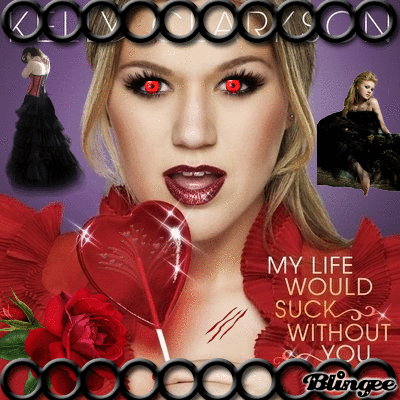
I was watching Breaking Dawn -- Part 2 this weekend when something occurred to me.
This is awesome, I thought. I mean, this is WAY awesome. This is the coolest thing ever. Nothing could be cooler than this! Wait...nothing could be cooler than this. Oh, my God. I've made some really bad life decisions.
Aside from revealing the striking depth of my emotional immaturity, my infatuation with the Twilight saga sheds light on a difficult truth in publishing: the profitability spikes in our field are more often than not driven by literary lightning, projects that illuminate the publishing world for a ferocious moment before disappearing and leaving a bunch of clouds behind.
Unsurprisingly, the biggest bolt of the hour tends to spawn smaller sparks who light up their own corners of the sky (preferably in a manner that achieves recoupment), which explains why Stephenie Meyer's accomplishment was followed by Vampire Academy and the television show True Blood, both of which capitalized on the niche Meyer exposed.
The reason for Twilight's success is not hard to grasp: her books provide readers with comforting visions of true love, handsome heroes, and supernatural power presented in a conveniently sexy package. Beneath the vampire/werewolf rivalry, Twilight is the story of a directionless young woman rescued by a rich, hot guy. Doesn't everyone secretly wish for something like that, at least once? If they don't, it's hard to explain how Fifty Shades of Grey (which started as Twilight fanfiction, mind you) has sold 65 million copies worldwide.
But what's next? Conventional wisdom, not to mention human nature, dictates that every trend has a shelf life, and with Twilight's last film installment done, vampires should be headed the way of the Baha Men (on a completely unrelated note, I'd like to point out that I hated that song back when it first debuted--even at 12 I demonstrated the effortless good taste that has since become my trademark).
That's right: Bella and her ilk are destined for a swift death.
Except they're not.
In fact, the vampire genre is still enjoying robust success long after it should have died down; the final book in the Twilight series was released in 2008, which means that vampire lore is captivating the reading public a full five years after the the era's greatest success wound up. That, much like Kelly Clarkson's Breakaway, constitutes some serious staying power.
Vampires have lurched on like the literal undead in publishing largely due to the absence of anything to replace them. In some corners of the industry there is a consensus emerging that zombies will be the new thing but, at the risk of demonstrating a dangerous lack of foresight, I'm going to call their bluff. Zombies may be a natural successor to vampires in a mythological sense, but they're missing everything that made vampires all the rage to begin with: good looks, sophistication, wealth, grace. Vampire stories tap into an archetype we all want to emulate; zombies are just us with hangovers and bad skin.
So it's vampires, at least for now. As for what comes afterward, your guess is hopefully only marginally worse than mine. There are only two things I know for sure: 1. Whatever displaces the vampire juggernaut will allow us to indulge in the same kind of fantasies Twilight did (see the profusion of successful romance novels of late) and 2. We probably won't see it coming.
Any ideas, guys?
As always, you can learn about my manuscript editing services here. This month I've had the privilege to work with two new writers, both of whom learned of me through the blog. That would not have happened without you having this ongoing conversation with me, so thanks for all your awesomeness!
And for my next trick: a contest...
Monday, February 25, 2013
Shaking It Up
I was asked in a recent interview if there was a genre of literature I wasn't getting enough submissions of and, conversely, if there was a genre of which I had too much.
The first one was easy: send me literary fiction, historical non-fiction, and women's literature. I consider works from many categories and those three are particularly underrepresented. The second part of the question, however, presented me with a conundrum: what do I have too much of?
The first--and easiest--answer was fantasy, but it also wasn't entirely true. I have a reputation, earned or not, as the fantasy guy--out of context that statement could make me sound sexy--and so I do receive a ton of fantasy manuscripts, but because it's a genre I enjoy the submission volume is not a problem per se. Nor is the writing, which is often even better than I anticipate. So, no, I don't get too much fantasy; I get too much fantasy that is, pardon the expression, by the book.
This, ladies and gentlemen, is a dancing elephant. It is not cleaning itself, or munching on leaves, or nudging its newborn along, but dancing. It is also, thankfully, relevant to the topic at hand, which is a good thing because the moment I saw it I knew I was going to post it here even if I couldn't find a way to work it in.
The elephant is dancing. Had it been doing anything other than the foxtrot, it would not have infatuated me and I would not have spent 45 minutes coming up with an excuse to make you look at it. It's dancing. It's still an elephant, but behaving in a most un-elephant-like manner, and therefore it caught my attention.
Such is the case with fantasy. Fantasy, like elephants, is inherently awesome, but if it sticks too close to what everyone expects it to be, people are likely to ignore or throw peanuts at it. So it needs to dance.
Like this bearded man.
I can't tell you how many manuscripts I've gotten about awkward adolescent males who are transported to another--usually medieval--world where they learn they are the chosen ones of an ancient prophecy and foretold to save all creation. The manuscripts are good, sure, and even publishing's favored child, Harry Potter, is a variant on their formula. But the same story can only be told so many times. If you're going to do fantasy, shake it up. Be a dancing elephant. Be a bearded man in a dress.
In case you're wondering where you might find an example of such shaken-up fantasy, I give you someone who is both a dancing elephant and a bearded man in a dress: George R.R. Martin.
For those of you who don't know, George R. R. Martin (often referred to as GRRM) is the author of the phenomenally successful A Song of Ice and Fire series, which features a wide array of characters battling for the throne of the fictional continent of Westeros. At first glance this seems like typical fantasy--medieval setting, queens riding dragons, magical swords being wielded by knights. It's not, though. The brilliance of the series is that it focuses on multifaceted characters interacting in a complex political environment. These characters and the world they inhabit are portrayed in so relatable a manner that the flourishes of magic they encounter seem believable.
For its fantastic setting and incredible premise, A Song of Ice and Fire is a human drama. It's fantasy with a twisted edge, fantasy that does not ignore sexuality or financial reality or the nature of man. It is, in essence, a dancing elephant--still an elephant, but way cooler than any other elephant you're going to come across.
That is the kind of fantasy I'd like to see; not a knock-off of Martin's achievement (or of A Game of Thrones, the rocking TV show inspired by his books) but fantasy that challenges fantasy conventions.
I, meanwhile, have decided to shake up my client catalogue--by adding a horror writer! I don't want to name names because we haven't crossed the Ts and dotted the Is, but it's happening and I can't wait to brag to you about it. I've also received my first blog-referred editing client. Remember that you can find my rates and editing contact information here.
I'm off to be a literary agent and will return around this time next week. Keep those elephants dancing while I'm gone.
The first one was easy: send me literary fiction, historical non-fiction, and women's literature. I consider works from many categories and those three are particularly underrepresented. The second part of the question, however, presented me with a conundrum: what do I have too much of?
The first--and easiest--answer was fantasy, but it also wasn't entirely true. I have a reputation, earned or not, as the fantasy guy--out of context that statement could make me sound sexy--and so I do receive a ton of fantasy manuscripts, but because it's a genre I enjoy the submission volume is not a problem per se. Nor is the writing, which is often even better than I anticipate. So, no, I don't get too much fantasy; I get too much fantasy that is, pardon the expression, by the book.
This, ladies and gentlemen, is a dancing elephant. It is not cleaning itself, or munching on leaves, or nudging its newborn along, but dancing. It is also, thankfully, relevant to the topic at hand, which is a good thing because the moment I saw it I knew I was going to post it here even if I couldn't find a way to work it in.
The elephant is dancing. Had it been doing anything other than the foxtrot, it would not have infatuated me and I would not have spent 45 minutes coming up with an excuse to make you look at it. It's dancing. It's still an elephant, but behaving in a most un-elephant-like manner, and therefore it caught my attention.
Such is the case with fantasy. Fantasy, like elephants, is inherently awesome, but if it sticks too close to what everyone expects it to be, people are likely to ignore or throw peanuts at it. So it needs to dance.
Like this bearded man.
I can't tell you how many manuscripts I've gotten about awkward adolescent males who are transported to another--usually medieval--world where they learn they are the chosen ones of an ancient prophecy and foretold to save all creation. The manuscripts are good, sure, and even publishing's favored child, Harry Potter, is a variant on their formula. But the same story can only be told so many times. If you're going to do fantasy, shake it up. Be a dancing elephant. Be a bearded man in a dress.
In case you're wondering where you might find an example of such shaken-up fantasy, I give you someone who is both a dancing elephant and a bearded man in a dress: George R.R. Martin.
For those of you who don't know, George R. R. Martin (often referred to as GRRM) is the author of the phenomenally successful A Song of Ice and Fire series, which features a wide array of characters battling for the throne of the fictional continent of Westeros. At first glance this seems like typical fantasy--medieval setting, queens riding dragons, magical swords being wielded by knights. It's not, though. The brilliance of the series is that it focuses on multifaceted characters interacting in a complex political environment. These characters and the world they inhabit are portrayed in so relatable a manner that the flourishes of magic they encounter seem believable.
For its fantastic setting and incredible premise, A Song of Ice and Fire is a human drama. It's fantasy with a twisted edge, fantasy that does not ignore sexuality or financial reality or the nature of man. It is, in essence, a dancing elephant--still an elephant, but way cooler than any other elephant you're going to come across.
That is the kind of fantasy I'd like to see; not a knock-off of Martin's achievement (or of A Game of Thrones, the rocking TV show inspired by his books) but fantasy that challenges fantasy conventions.
I, meanwhile, have decided to shake up my client catalogue--by adding a horror writer! I don't want to name names because we haven't crossed the Ts and dotted the Is, but it's happening and I can't wait to brag to you about it. I've also received my first blog-referred editing client. Remember that you can find my rates and editing contact information here.
I'm off to be a literary agent and will return around this time next week. Keep those elephants dancing while I'm gone.
Tuesday, February 12, 2013
Literary Agent on a Rampage
Folks, the Internet just isn't enough for me anymore.
Not that interacting with you in an online forum isn't great. I mean, really, it's been smashing. But it's occurred to me recently that the enviable obligations imposed upon me by my job would be even more enjoyable if not performed for ten hours a day in the anemic glow of a computer screen.
So, like rock 'n' roll legends and my Viking ancestors before me, I'm going on tour.
Except it's more of an expedition. Complete with anachronistic hat.*
In my last post I mentioned that my father is a crazy Welshman. What I failed to mention is that my mother is a crazy Swede (who's from Philadelphia--best not to look too deeply into that), and it is from her that I inherited my predilection for daring nighttime raids on English monasteries, adeptness with 9th-century combat techniques, and fondness for smoked fish.
Unlike those other Vikings, though, I am civilized, so instead of spreading chaos and terror I'm spreading...um, tips for how to write commercially viable literature. Oh, and wine. I'm fond of wine. I guess that doesn't sound as terrifying as I intended, but trust me, wine and writing can make for a pretty fearsome combination.
Anyway.
For those of you who might be interested, my upcoming schedule is as follows:
*I really wish I had an anachronistic hat
Not that interacting with you in an online forum isn't great. I mean, really, it's been smashing. But it's occurred to me recently that the enviable obligations imposed upon me by my job would be even more enjoyable if not performed for ten hours a day in the anemic glow of a computer screen.
So, like rock 'n' roll legends and my Viking ancestors before me, I'm going on tour.
Except it's more of an expedition. Complete with anachronistic hat.*
In my last post I mentioned that my father is a crazy Welshman. What I failed to mention is that my mother is a crazy Swede (who's from Philadelphia--best not to look too deeply into that), and it is from her that I inherited my predilection for daring nighttime raids on English monasteries, adeptness with 9th-century combat techniques, and fondness for smoked fish.
Unlike those other Vikings, though, I am civilized, so instead of spreading chaos and terror I'm spreading...um, tips for how to write commercially viable literature. Oh, and wine. I'm fond of wine. I guess that doesn't sound as terrifying as I intended, but trust me, wine and writing can make for a pretty fearsome combination.
Anyway.
For those of you who might be interested, my upcoming schedule is as follows:
- May 28 - 31: I might be attending the Book Expo America in New York. This one is still up in the air, but if I can make it work with my schedule it is so happening.
- June 29: I will definitely be addressing the Northern Virginia Writers' Group in Fairfax, Virginia on this date. If you're in the area, come out and enjoy an incredibly awkward interaction with me. Politely ignore my hunchback.
- July 25 - 28: I will be attending the Pacific Northwest Writers Association 2013 Conference at the Seattle Airport Hilton. Registration is ongoing.
- September 19 - 21: I will be attending the Hampton Roads Writers 2013 Conference in Virginia Beach, Virginia
And in case basking in my literary luminescence (just...just humor me on this one) on only four occasions this year is not enough to satisfy your no doubt insatiable demand, I have decided to make myself available for private editing. You can find details, such as rates, at the Ethan Vaughan Editing page.
Some of you may recall that in a previous post I said clients would use my services at their peril. This is not because I will add you on Facebook, chat you up, and make embarrassing details of your dating life public. It is not because I suffer from a rare autoimmune disease that is transmissible through e-mailed manuscripts. It is not even because I will do a horrible job on your manuscript (fingers crossed on that last one). It's because of a pesky thing called ethics.
Kimberley Cameron & Associates is a member of the Association of Authors' Representatives, whose code of conduct states that, among other things, associated agencies will not charge clients for representation or related services. This is a helpful little regulation that stops "agents" from frisking authors and makes it incumbent upon real agents to actually get things published. Convenient, I know.
Unfortunately, it also means that if you pay me to edit your manuscript and then I like your project enough to represent it, it looks like we are both doing something naughty.
Which we would obviously never do.
So, the solution: there are agenting clients and there are editing clients and ne'er the two shall meet. You can send me your manuscript and I will happily whip it into commercial-ready shape for a fee that I probably think is reasonable only because I really like Ramen Noodles. If you have given me a Ramen-destined check, however, I cannot consider you for literary representation. Given my stature within the publishing industry I can understand what a blow this must be, but somehow we'll all have to live with it.
And in the meantime you will, all joking aside, get the editing perspective of someone who evaluates and improves manuscripts for a living. But don't take my word for it! Take...Yvonne Osborne's! She's supposed to do a post. It's probably not there, but it will be. In the meantime, here is her testimonial:
"If you are looking for a manuscript editor, I would highly recommend Ethan Vaughan. His uncanny ability to sift through the superfluous passages to expose your literary gem is nothing short of amazing. From a line of uncharacteristic dialogue, to an unlikely turn of events, Ethan will unearth the mistakes you cannot see for yourself and a less obtuse editor would miss. He points out the strengths of the story at the same time he identifies the encumbrances. He did a 'reader's report' for me that in itself is a pleasure to read. His command of language combined with a nose for fraudulent, redundant details makes for colorful reporting and is a skill not always found in the league of editors. Ethan is professional and perceptive and a pleasure to work with."
Not too shabby, Ms. Osborne. Not too shabby.
Please see my page for rates, my editing e-mail contact (evaughanmail@gmail.com), and testimonials from clients. Well, that's enough self-promotion on Blogger for one night. Now I'm off to self-promote on Twitter. Peace out, Girl Scouts.
*I really wish I had an anachronistic hat
Monday, February 4, 2013
How to Write a Good Query...Hopefully
After my last post, I was feeling pretty damn smug.
That thing about the high iron gates was mad deep, I thought. Now they'll totally be at ease because they'll know I'm that cool literary agent who's been there.
To which you might respond, "Right."
Because it's easy to be all tranquil and Zen and whatnot when you're the guy judging the queries. It's a whole different situation when you're the one waiting for judgement to be passed.
But oh, how the tables have turned. Now I'm the one behind the query. And boy am I scared.
Most uninitiated people (and I'm sure that includes none of us) tend to conflate agents and editors, which is why I have to routinely explain to my family and friends that I don't actually publish books. Someone else does that. If I can convince them to. Oh, and if I fail then I won't get paid and I'll wind up living up in a cardboard box.
There's a beautiful sort of poetic justice there; literary agents critique others for a living but have to pass muster themselves if they want to eat something other than Ramen noodles for the next six months. Even the most prestigious of us--and I definitely don't fall into that category--is reduced at routine intervals to repeatedly refreshing his inbox and agonizing over whether his query letter was rendered too cheeky by the use of the word "smorgasbord."
Sound familiar?
Seeing as that's where I am right now I figured now would be as good a time as any to review effective query letter writing. For, as my crazy Welshman father would say, "Presentation is half the battle."
He, of course, was referring to veal parmesan, scallops, and brussel sprouts--which need a hell of a lot of presentation to be palatable to anyone--but the principle still holds. You can have the best manuscript in the world, but if you can't market it effectively it's more than likely to go unread.
So how does one write an effective query? I really hope I know this, because I'm sending two of them out and will soon be the laughingstock of the entire publishing industry if I get it wrong.
The general formula is the Hook, Bait, and Switch. The Hook draws a reader's attention, the Bait provides them the meat of the story to sink their teeth into, and the Switch wraps things up with some very basic information about the author. This arrangement works well across genres but should, obviously, be tailored to fit manuscripts' individual style.
Let's discuss the clients whose work I'm submitting. Gerry Dodge and S.E. Smith are both phenomenal writers and I'm enthusiastic about both of their projects. S.E.'s book, however, is a zany YA tome that had me laughing out loud while Gerry's is a piece of serious literary fiction that, I kid you not, was still making me cry the fifth time I read it.
We'll start with Gerry's novel, Beneath the Weight of Sadness. It's the kind of story you will never forget reading. I believe, at the risk of sounding unbearably corny, that it has the makings of an American classic. The query for it was more difficult to write, though, because its complex message is not as easily encapsulated as a more lighthearted manuscript's might be.
Hook: Nothing prepares you for the loss of a child. Nothing.
Any parent would agree with that. The first sentence is immediate and visceral.
Bait: And when Ethan Engroff’s gay seventeen-year-old son Truman is savagely beaten to death by an unknown assailant, the murder is just the beginning of a long and painful odyssey. As Ethan’s wife Amy drifts further from reality, Ethan must face difficult truths about his marriage, his shortcomings as a father, and who his son really was—and could have been.
This provides a glimpse into what the story is about but, notably, is not a synopsis. Synopses have their place, but it's not in the inbox of an agent who received fifty submissions that day (unless you attach it as a document). You want to keep the Bait part of your query brief; touch on the major conflict and then let the agent's curiosity do the rest. If you've set your Bait up the right way and the agent is searching for work in your genre, this will usually work.
Switch: This is where you reel 'em in with your dazzling life story. Your dazzling life story, by the way, is about three sentences long. Since I got my authors' permission to brag about them but not to reveal the locations of their secret lairs, we'll use my life as the Switch example.
Five Different Ways to Win an Albanian Moose Race is a 100,000-word non-fiction memoir and the debut work from Ethan Vaughan. Ethan is a journalist and literary agent whose work has appeared in The Most Awesome Newspaper Ever. He's been told he has very nice hair.
Include the word count of your manuscript, its genre, and the two or three most salient facts about yourself. That's really all you need.
And now, let's switch gears. Ladies and gentlemen, we are entering the realm of YA.
YA is a party! Hopefully not a stripper party--I'm not sure what those two people are doing on stage--since we're talking about teenagers, but definitely a party! There's pretty lights, and disco balls, and fruit punch and CUPCAKES. This post has involved more food than it should. But, anyway.
YA is fun to write, fun to read, and fun to talk about, which is why the queries written for it tend to work with the Hook, Bait, and Switch method so nicely.
S.E.'s novel, The Transformation(s) of Tabitha Grey, is about a sixteen-year-old transgender witch who has to figure out why dark wizards are running amok in her town. I know you got to "transgender witch" and did a double take, but trust me, this works. The first chapter opens with the protagonist randomly getting turned into a deer. Does life get much better?
And so, the query.
Hook: Tabitha Grey thought her life was weird enough. And not regular sixteen-year-old girl weird. More like, my-house-can-think-and-it-might-eat-you weird. Oh, and did she mention that her father is a warlock masquerading as an herbalist? Or that her pets are three centuries-old ravens? Or that she’s transgender? Yeah, life as Tabitha can be pretty awkward.
This is longer than the literary fiction hook, but S.E.'s book has more novel--if you'll pardon the pun--elements to latch on to. I just threw a whole plateful of weird at some editor's head, but because a lot of YA is based on teenagers wryly commenting on the craziness around them, it works (I think).
Bait: But when someone unleashes powerful dark magic on her town and begins abducting residents, life goes from awkward to scary fast. Now Tabitha Grey has to help her father find the culprit and try to figure out what kind of power she and her twin brother will inherit when they turn seventeen, all while navigating her transgender transformation.
That thing about the high iron gates was mad deep, I thought. Now they'll totally be at ease because they'll know I'm that cool literary agent who's been there.
To which you might respond, "Right."
Because it's easy to be all tranquil and Zen and whatnot when you're the guy judging the queries. It's a whole different situation when you're the one waiting for judgement to be passed.
But oh, how the tables have turned. Now I'm the one behind the query. And boy am I scared.
Most uninitiated people (and I'm sure that includes none of us) tend to conflate agents and editors, which is why I have to routinely explain to my family and friends that I don't actually publish books. Someone else does that. If I can convince them to. Oh, and if I fail then I won't get paid and I'll wind up living up in a cardboard box.
There's a beautiful sort of poetic justice there; literary agents critique others for a living but have to pass muster themselves if they want to eat something other than Ramen noodles for the next six months. Even the most prestigious of us--and I definitely don't fall into that category--is reduced at routine intervals to repeatedly refreshing his inbox and agonizing over whether his query letter was rendered too cheeky by the use of the word "smorgasbord."
Sound familiar?
Seeing as that's where I am right now I figured now would be as good a time as any to review effective query letter writing. For, as my crazy Welshman father would say, "Presentation is half the battle."
He, of course, was referring to veal parmesan, scallops, and brussel sprouts--which need a hell of a lot of presentation to be palatable to anyone--but the principle still holds. You can have the best manuscript in the world, but if you can't market it effectively it's more than likely to go unread.
So how does one write an effective query? I really hope I know this, because I'm sending two of them out and will soon be the laughingstock of the entire publishing industry if I get it wrong.
The general formula is the Hook, Bait, and Switch. The Hook draws a reader's attention, the Bait provides them the meat of the story to sink their teeth into, and the Switch wraps things up with some very basic information about the author. This arrangement works well across genres but should, obviously, be tailored to fit manuscripts' individual style.
Let's discuss the clients whose work I'm submitting. Gerry Dodge and S.E. Smith are both phenomenal writers and I'm enthusiastic about both of their projects. S.E.'s book, however, is a zany YA tome that had me laughing out loud while Gerry's is a piece of serious literary fiction that, I kid you not, was still making me cry the fifth time I read it.
We'll start with Gerry's novel, Beneath the Weight of Sadness. It's the kind of story you will never forget reading. I believe, at the risk of sounding unbearably corny, that it has the makings of an American classic. The query for it was more difficult to write, though, because its complex message is not as easily encapsulated as a more lighthearted manuscript's might be.
Hook: Nothing prepares you for the loss of a child. Nothing.
Any parent would agree with that. The first sentence is immediate and visceral.
Bait: And when Ethan Engroff’s gay seventeen-year-old son Truman is savagely beaten to death by an unknown assailant, the murder is just the beginning of a long and painful odyssey. As Ethan’s wife Amy drifts further from reality, Ethan must face difficult truths about his marriage, his shortcomings as a father, and who his son really was—and could have been.
Beneath the Weight of Sadness
is a heartrending story about a marriage shattered by grief, a town haunted by
hate, and how one unlived life can touch countless others.
This provides a glimpse into what the story is about but, notably, is not a synopsis. Synopses have their place, but it's not in the inbox of an agent who received fifty submissions that day (unless you attach it as a document). You want to keep the Bait part of your query brief; touch on the major conflict and then let the agent's curiosity do the rest. If you've set your Bait up the right way and the agent is searching for work in your genre, this will usually work.
Switch: This is where you reel 'em in with your dazzling life story. Your dazzling life story, by the way, is about three sentences long. Since I got my authors' permission to brag about them but not to reveal the locations of their secret lairs, we'll use my life as the Switch example.
Five Different Ways to Win an Albanian Moose Race is a 100,000-word non-fiction memoir and the debut work from Ethan Vaughan. Ethan is a journalist and literary agent whose work has appeared in The Most Awesome Newspaper Ever. He's been told he has very nice hair.
Include the word count of your manuscript, its genre, and the two or three most salient facts about yourself. That's really all you need.
And now, let's switch gears. Ladies and gentlemen, we are entering the realm of YA.
YA is a party! Hopefully not a stripper party--I'm not sure what those two people are doing on stage--since we're talking about teenagers, but definitely a party! There's pretty lights, and disco balls, and fruit punch and CUPCAKES. This post has involved more food than it should. But, anyway.
YA is fun to write, fun to read, and fun to talk about, which is why the queries written for it tend to work with the Hook, Bait, and Switch method so nicely.
S.E.'s novel, The Transformation(s) of Tabitha Grey, is about a sixteen-year-old transgender witch who has to figure out why dark wizards are running amok in her town. I know you got to "transgender witch" and did a double take, but trust me, this works. The first chapter opens with the protagonist randomly getting turned into a deer. Does life get much better?
And so, the query.
Hook: Tabitha Grey thought her life was weird enough. And not regular sixteen-year-old girl weird. More like, my-house-can-think-and-it-might-eat-you weird. Oh, and did she mention that her father is a warlock masquerading as an herbalist? Or that her pets are three centuries-old ravens? Or that she’s transgender? Yeah, life as Tabitha can be pretty awkward.
This is longer than the literary fiction hook, but S.E.'s book has more novel--if you'll pardon the pun--elements to latch on to. I just threw a whole plateful of weird at some editor's head, but because a lot of YA is based on teenagers wryly commenting on the craziness around them, it works (I think).
Bait: But when someone unleashes powerful dark magic on her town and begins abducting residents, life goes from awkward to scary fast. Now Tabitha Grey has to help her father find the culprit and try to figure out what kind of power she and her twin brother will inherit when they turn seventeen, all while navigating her transgender transformation.
And
she’d better be sharp. This dark plot is more than what it seems, and it just
might take the person closest to her.
Duh duh duh. Not all ABBA remixes and ice cream floats now, is it? The Bait in this case shows that the unusual premise has some substance behind it.
Switch: The Transformation(s) of Tabitha
Grey
is a 49,000-word young-adult fantasy with a sardonic twist. It is the first in
a trilogy from S.E. Smith that follows the magical Grey family on their odyssey
to stop an evil cohort of warlocks hell bent on taking over the world—with a
zombie army at their backs.
S.E. Smith is a professional ass-kicker and can make cheesecake that has mystical powers.
BAM. And I don't mean that like an editor's door being slammed in my face, I mean BAM like we just high-fived because we're so awesome. And stuff.
And one last thing: even if you are not a grammar Nazi or a spelling fascist in your day-to-day life, make sure that your query letter is English-teacher worthy before you send it in. If an agent gets into a manuscript whose premise he likes and finds a few errors here and there, he's probably going to ignore them with the knowledge that he can do some editing later on if he decides to represent you. If your query letter has gaping errors in spelling, punctuation, or grammar, though, it can cast serious aspersions on your ability to execute a full-length book. That kind of submission will find its way quickly to the No box.
I hope I've imparted something meaningful in between my tripe about Welshmen and disco balls. And if I haven't, well, then prepare to hear me openly mocked at the next conference you attend. Not worried too much, though. I'm like a solid sixty-five percent sure I did this right.
Monday, January 21, 2013
Searching for Way More Stories 'Cause Now I'm an Agent
Remember how back in May I promised I'd never abandon you? And then remember how I immediately abandoned you?
Yeah, that happened. And since I can't really pretend I haven't been gone for eight months, or maybe blame my departure on a particularly bad case of food poisoning, I'll just 'fess up. I got busy. Stuff happened. I slept a bit.
To be fair, this absence was a lot more justifiable than the first time I callously left to you to the literary wilds back in November 2011. Back then I really had no out. It was the Thanksgiving of my last year in college and I basically just decided to watch YouTube and eat turkey for a few months straight.
This time around, though, a lot happened. I got a personal trainer. I went vegan.* I had a haircut or two. And, oh yeah: I became a literary agent.
No big deal. Except it was. Like, the hugest deal ever.
Shortly before I was hired in August 2012 I was having a conversation with a good friend of mine about pursuing dreams and how badly I wanted to pursue mine.
"I just love literature so much," I said. "I want it to be my career. And I'm, you know--I'm so nervous about whether that's tenable."
"Well, hey," he said, tapping my adorable shoulder. "Don't give up. I'm sure the writing thing will work out for you. And you can fall back on the literary agent stuff until it does."
"What? The literary agent thing is the dream."
"Oh, I thought you wanted to be an artist. I mean...that would be a lot more romantic."
"What could be more romantic than commercially viable fiction?"
"Pretty much anythin--"
"And occasional non-fiction proposals, too."
For many of you, of course, the news of my dramatic ascent--do not contradict me on this--is not new, a fact that I find quite flattering. But for the few people who haven't been avidly following my career, I'll get you up to speed: in December 2011 I began interning with San Francisco-based Kimberley Cameron & Associates, and in August 2012 they hired me as an agent. Above you can see me with my colleague and fellow agent, Elizabeth Kracht.
The hiring was, well, magical. It mostly consisted of my jumping up and down and screaming in a girlish manner while Elizabeth attempted to say something sensible.
My grandmother, who unfortunately for the world is very, very dead, would have been appalled to see the spectacle I made.
"Ethan, collect yourself," I can hear her saying. "You're behaving like some Northumbrian parvenu."
To which I would have replied, "I don't know what one of those words means and you are the weirdest racist ever."
But I digress.
The fact of the matter is that it has been an enormous privilege for me to work with Kimberley Cameron. Under her stewardship I have learned a great deal about publishing and have been given the opportunity to search for many, many stories. Except this time you guys are in on the plot. Before I had to seek out prospective manuscripts through this site and now you send them, by the boat load, to me. It's an arrangement I rather like.
My hope is that the blog, which so many of the hopefuls who submit to Kimberley Cameron have identified with my name, can become a forum wherein I interact with authors, readers, those who have submitted or want to submit, and even those who are just interested in literature. My other hope is that, if authors who have sent us their stories can read regular updates for me, they'll know I haven't forgotten they exist.
Someone set up a page on Query Tracker to keep tabs on me, and one of the commentators--yes, I totally am that person who reads his own comments, so don't talk smack on me because I will so know about it--recently said, "It seems like we're a mob of people waiting outside these high iron gates. And waiting to see which select few get allowed inside."
Maybe I'm just sappy, but something about that really struck me. It's so incredibly difficult to lay your hopes out for someone else's scrutiny, to know that a word from them could make your dreams come true or put everything on hold. I get that. I've been there. And having that authority is a responsibility that I, and everyone at Kimberley Cameron, take seriously.
We read every query. We evaluate every project. And while it may take more time than we'd like--my inbox looks like the Amazon rain forest--we eventually get to everyone. But you know, feel free to prod us. Feel free to ask me questions, here or by e-mail. And feel free to query! Send your goodies to ethan@kimberleycameron.com.
Over the next...um, ever, I guess, I'll be keeping you in the loop about my professional escapades and responding to any questions you have. I am also considering offering editing services--which you will make use of at your peril, though that is for another post--and, provided I can make the time, will post details about that soon.
So, good writing and good reading and thanks for hanging on! If you're there. Which you're probably not. I mean, it's been eight months. Oh, well. At least now I'm returning to blogging as a mature and seasoned publishing professional.
*I'm not actually a vegan.
Yeah, that happened. And since I can't really pretend I haven't been gone for eight months, or maybe blame my departure on a particularly bad case of food poisoning, I'll just 'fess up. I got busy. Stuff happened. I slept a bit.
To be fair, this absence was a lot more justifiable than the first time I callously left to you to the literary wilds back in November 2011. Back then I really had no out. It was the Thanksgiving of my last year in college and I basically just decided to watch YouTube and eat turkey for a few months straight.
This time around, though, a lot happened. I got a personal trainer. I went vegan.* I had a haircut or two. And, oh yeah: I became a literary agent.
No big deal. Except it was. Like, the hugest deal ever.
Shortly before I was hired in August 2012 I was having a conversation with a good friend of mine about pursuing dreams and how badly I wanted to pursue mine.
"I just love literature so much," I said. "I want it to be my career. And I'm, you know--I'm so nervous about whether that's tenable."
"Well, hey," he said, tapping my adorable shoulder. "Don't give up. I'm sure the writing thing will work out for you. And you can fall back on the literary agent stuff until it does."
"What? The literary agent thing is the dream."
"Oh, I thought you wanted to be an artist. I mean...that would be a lot more romantic."
"What could be more romantic than commercially viable fiction?"
"Pretty much anythin--"
"And occasional non-fiction proposals, too."
For many of you, of course, the news of my dramatic ascent--do not contradict me on this--is not new, a fact that I find quite flattering. But for the few people who haven't been avidly following my career, I'll get you up to speed: in December 2011 I began interning with San Francisco-based Kimberley Cameron & Associates, and in August 2012 they hired me as an agent. Above you can see me with my colleague and fellow agent, Elizabeth Kracht.
The hiring was, well, magical. It mostly consisted of my jumping up and down and screaming in a girlish manner while Elizabeth attempted to say something sensible.
My grandmother, who unfortunately for the world is very, very dead, would have been appalled to see the spectacle I made.
"Ethan, collect yourself," I can hear her saying. "You're behaving like some Northumbrian parvenu."
To which I would have replied, "I don't know what one of those words means and you are the weirdest racist ever."
But I digress.
The fact of the matter is that it has been an enormous privilege for me to work with Kimberley Cameron. Under her stewardship I have learned a great deal about publishing and have been given the opportunity to search for many, many stories. Except this time you guys are in on the plot. Before I had to seek out prospective manuscripts through this site and now you send them, by the boat load, to me. It's an arrangement I rather like.
My hope is that the blog, which so many of the hopefuls who submit to Kimberley Cameron have identified with my name, can become a forum wherein I interact with authors, readers, those who have submitted or want to submit, and even those who are just interested in literature. My other hope is that, if authors who have sent us their stories can read regular updates for me, they'll know I haven't forgotten they exist.
Someone set up a page on Query Tracker to keep tabs on me, and one of the commentators--yes, I totally am that person who reads his own comments, so don't talk smack on me because I will so know about it--recently said, "It seems like we're a mob of people waiting outside these high iron gates. And waiting to see which select few get allowed inside."
Maybe I'm just sappy, but something about that really struck me. It's so incredibly difficult to lay your hopes out for someone else's scrutiny, to know that a word from them could make your dreams come true or put everything on hold. I get that. I've been there. And having that authority is a responsibility that I, and everyone at Kimberley Cameron, take seriously.
We read every query. We evaluate every project. And while it may take more time than we'd like--my inbox looks like the Amazon rain forest--we eventually get to everyone. But you know, feel free to prod us. Feel free to ask me questions, here or by e-mail. And feel free to query! Send your goodies to ethan@kimberleycameron.com.
Over the next...um, ever, I guess, I'll be keeping you in the loop about my professional escapades and responding to any questions you have. I am also considering offering editing services--which you will make use of at your peril, though that is for another post--and, provided I can make the time, will post details about that soon.
So, good writing and good reading and thanks for hanging on! If you're there. Which you're probably not. I mean, it's been eight months. Oh, well. At least now I'm returning to blogging as a mature and seasoned publishing professional.
*I'm not actually a vegan.
Tuesday, May 8, 2012
A Tip: Rejection Is...Good
Okay, so maybe it's not good. I mean, no one likes rejection. Why, just the other day I was informed that my lemon meringue was "dry and unpleasant, with the taste of a dirty sock and a texture not unlike the gravel one might find on one of West Virginia's more hazardous roadways." To which I responded by crying "Rapscallion!" and challenging my great-aunt to a duel.
But I digress.
My point is that rejection in the publishing industry, while it might not feel good, is by no means bad. In fact, it's often a blessing in disguise.
You see, the fact of the matter is that most people just don't know how to write saleable books. This has nothing to do with talent. One of the sadder truths of publishing is that the most gifted writers are often the least likely to see their work come to light. That largely derives from the fact that the publishing industry is in essence part of the entertainment industry and, as anyone who's ever seen the Grammys can tell you, the entertainment industry is not a talent competition.
Take Kesha. Oh, sorry, Ke$ha.
You see, this is what you want to be. Sparkly, gauche, a little bit sticky, and likely of questionable personal hygiene. Well, at least in spirit. Can the young woman before you dance? No. Can she sing? Hell no. But she knows the formula, and as a result she's sold 3 million records.
So it is in the publishing industry.
You may be the most talented writer ever, but if you don't use that talent to write about something people want to read about, and in a way that makes it easy for them to do so, you're not likely to meet with success. I know from personal experience. As a writer myself I made the mistake countless times (and have the rejection letters to prove it) and as an agent-in-waiting I can recognize it in others (my newer work, as you can imagine, is much different than what I was writing two or three years ago).
Now, granted, the whole music-industry analogy is limited; you can become a pop star without being able to sing, but if you can't string a coherent sentence together there's no way you're going to get published no matter how great your premise is. Still, the conceit has its merits. There are certain conventions within publishing that, when honored, make the likelihood of success substantially higher.
In YA, for instance, relatability is key. Your protagonist should speak in a straightforward, distinctive voice that teenagers will find easy to empathize with. Humor in the narrative voice is a big plus, also; I've read manuscripts that hooked me on their wry, zany observational tone alone.
Genres and sub-genres aside, there are some rules that apply across the industry. Be concise. Get to the point. Keep the plot moving so the reader doesn't lose interest. Accessibility is essential and wordiness is accessibility's arch-nemesis, so cut down on the adverbs and never use a ten-dollar word where a five-cent one would suffice.
And be thankful for your rejection letters.
One of the common misconceptions about literary agents, and one I had as an aspiring writer, is that they sit around all day cackling maniacally as they use writers' submissions for kindling. It's not the case. Very few literary agents take any joy in sending out rejections--though there are some choice superstars--and for most the process is difficult, not just because they're delivering a blow but because often they know a project is viable.
Why would an agent reject a viable project?
Because there are only so many hours in the day. That's really what it boils down to. Any agent worth his salt devotes a tremendous amount of time and energy to manuscripts he takes on, and given the level of commitment required it's impossible to manage more than a handful at once without doing a disservice to the client. Most of the stories I've rejected (and there have been hundreds of them) haven't been clearly unfit; most are good, very good even, but not as good as the best thing I've gotten, and that best thing must take priority.
So take heart. A rejection letter does not make you a bad writer or even make your project a bad project, and oftentimes a manuscript that doesn't work for one agent will work for another. Plus a rejection, if it comes with feedback, can be one of your greatest tools in your development as a writer. Keep those chins up.
And for goodness' sakes be gracious.
The publishing industry is small--my literary agent supervisor had the daring to call it "incestuous"--and nothing rankles its members quite so much as the author who pours venom back at an agent. Trust me, you don't want that reputation.
Speaking of letters, both of rejection and acceptance, I'm close to choosing my May 2012 Author of the Month! Thanks to everyone who submitted and wish me luck for an awesome read to come!
But I digress.
My point is that rejection in the publishing industry, while it might not feel good, is by no means bad. In fact, it's often a blessing in disguise.
You see, the fact of the matter is that most people just don't know how to write saleable books. This has nothing to do with talent. One of the sadder truths of publishing is that the most gifted writers are often the least likely to see their work come to light. That largely derives from the fact that the publishing industry is in essence part of the entertainment industry and, as anyone who's ever seen the Grammys can tell you, the entertainment industry is not a talent competition.
Take Kesha. Oh, sorry, Ke$ha.
You see, this is what you want to be. Sparkly, gauche, a little bit sticky, and likely of questionable personal hygiene. Well, at least in spirit. Can the young woman before you dance? No. Can she sing? Hell no. But she knows the formula, and as a result she's sold 3 million records.
So it is in the publishing industry.
You may be the most talented writer ever, but if you don't use that talent to write about something people want to read about, and in a way that makes it easy for them to do so, you're not likely to meet with success. I know from personal experience. As a writer myself I made the mistake countless times (and have the rejection letters to prove it) and as an agent-in-waiting I can recognize it in others (my newer work, as you can imagine, is much different than what I was writing two or three years ago).
Now, granted, the whole music-industry analogy is limited; you can become a pop star without being able to sing, but if you can't string a coherent sentence together there's no way you're going to get published no matter how great your premise is. Still, the conceit has its merits. There are certain conventions within publishing that, when honored, make the likelihood of success substantially higher.
In YA, for instance, relatability is key. Your protagonist should speak in a straightforward, distinctive voice that teenagers will find easy to empathize with. Humor in the narrative voice is a big plus, also; I've read manuscripts that hooked me on their wry, zany observational tone alone.
Genres and sub-genres aside, there are some rules that apply across the industry. Be concise. Get to the point. Keep the plot moving so the reader doesn't lose interest. Accessibility is essential and wordiness is accessibility's arch-nemesis, so cut down on the adverbs and never use a ten-dollar word where a five-cent one would suffice.
And be thankful for your rejection letters.
One of the common misconceptions about literary agents, and one I had as an aspiring writer, is that they sit around all day cackling maniacally as they use writers' submissions for kindling. It's not the case. Very few literary agents take any joy in sending out rejections--though there are some choice superstars--and for most the process is difficult, not just because they're delivering a blow but because often they know a project is viable.
Why would an agent reject a viable project?
Because there are only so many hours in the day. That's really what it boils down to. Any agent worth his salt devotes a tremendous amount of time and energy to manuscripts he takes on, and given the level of commitment required it's impossible to manage more than a handful at once without doing a disservice to the client. Most of the stories I've rejected (and there have been hundreds of them) haven't been clearly unfit; most are good, very good even, but not as good as the best thing I've gotten, and that best thing must take priority.
So take heart. A rejection letter does not make you a bad writer or even make your project a bad project, and oftentimes a manuscript that doesn't work for one agent will work for another. Plus a rejection, if it comes with feedback, can be one of your greatest tools in your development as a writer. Keep those chins up.
And for goodness' sakes be gracious.
The publishing industry is small--my literary agent supervisor had the daring to call it "incestuous"--and nothing rankles its members quite so much as the author who pours venom back at an agent. Trust me, you don't want that reputation.
Speaking of letters, both of rejection and acceptance, I'm close to choosing my May 2012 Author of the Month! Thanks to everyone who submitted and wish me luck for an awesome read to come!
Subscribe to:
Posts (Atom)